AI Proof-of-Concept Cost: Scope, Timeline, and Realistic Budget
HM
Helmy Maulidina
Marketing Director
Buyers evaluating an AI proof of concept usually expect a quote tied to the model itself, when the real cost driver is almost always data readiness. This guide breaks down what actually shapes the price, timeline, and scope of a first AI pilot.
The Short Answer on AI Proof-of-Concept Cost
A well-scoped AI proof of concept typically runs four to eight weeks and costs a fraction of a full production build, because it deliberately limits scope to a single testable hypothesis. The exact number depends heavily on data readiness, not on the sophistication of the model.
Buyers evaluating AI proof of concept cost usually expect a quote tied to the model itself. In practice, the biggest cost driver is almost always how much data preparation and integration work the pilot requires.
Treat the proof-of-concept budget as an investment in an answer, not in a deliverable. You are paying to find out, cheaply, whether a full build is worth funding at all.
This guide covers what typically drives cost up or down, how a proof-of-concept budget compares to a full build, a realistic timeline breakdown, what's usually included and excluded, and the questions to ask a vendor before signing anything.
What Actually Drives the Cost
Three factors drive AI proof-of-concept cost more than anything else: data accessibility, integration complexity, and how tightly the use case is scoped.
Data accessibility matters because messy, scattered, or unlabeled data adds weeks of preparation work before any modeling begins. A team with a clean, centralized dataset can often start modeling in the first week; a team without one may spend most of the pilot just getting data ready.
In our own AI scoping calls, the most common budget surprise we see is a client assuming their data is "basically ready" when it is spread across four systems with inconsistent formats. That mismatch is discoverable in a short technical audit before committing to a fixed price.
Integration complexity is the second driver. A proof of concept that only needs to read from one system and output a report is far cheaper than one that must write back into a live production workflow.
Proof of Concept vs Full Build: Cost and Scope Compared
A proof of concept and a full production build differ in almost every dimension that drives cost, not just size.
Factor
Proof of Concept
Full Production Build
Typical duration
4-8 weeks
3-6+ months
Relative cost
Low, fixed scope
Substantially higher, phased
Data pipeline
Batch or sample-based
Live, monitored, governed
Infrastructure
Minimal, often temporary
Production-grade, scalable
Support after delivery
None or limited
Ongoing maintenance and monitoring
This is why we recommend treating the proof-of-concept budget as separate from the production budget entirely. Approving them as one combined number tends to inflate the pilot's cost and slow down the decision to even start.
A Realistic Timeline Breakdown
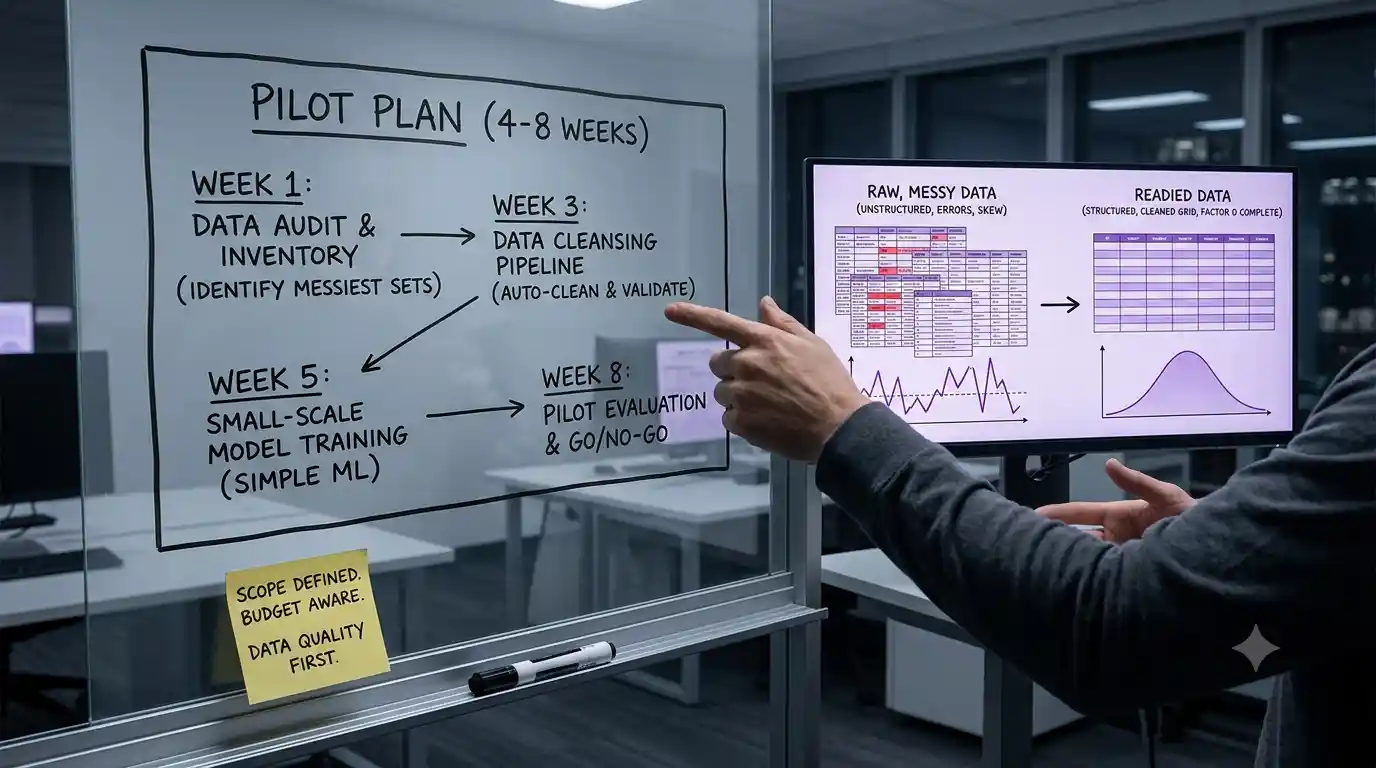
A typical eight-week proof of concept breaks into four roughly equal phases: scoping and data audit, data preparation, modeling and iteration, and results evaluation.
Scoping and data audit usually take one to two weeks and determine most of the eventual budget. Data preparation, often underestimated, can take another two to three weeks depending on how clean the source data already is.
Modeling and iteration is usually the shortest phase in well-scoped pilots, because a narrow use case means fewer variables to tune. The final evaluation week is when you compare results against the success threshold you agreed on before starting.
If your organization is unsure whether it even has enough historical data to run this timeline, that's a common concern worth addressing directly; see machine learning without enough data for practical starting points.
What's Usually Included and What's Not
A proof of concept typically includes data audit, a working model or system tested against historical or sampled data, and a results report against the agreed success metric. It does not typically include production infrastructure, ongoing monitoring, or user interface polish.
Vendors who quote a proof of concept price that already includes production deployment are usually either padding the estimate or planning to cut corners on the pilot itself. Keep the two phases separate in any contract.
A clear proof of concept also excludes broad feature requests that emerge mid-project. If a stakeholder wants to add a new capability halfway through, that belongs in the next phase's scope, not squeezed into the fixed pilot budget.
Questions to Ask Before You Sign
Before signing a proof-of-concept contract, ask exactly what success looks like, who owns the data during the engagement, and what happens to the work if you decide not to continue.
Ask specifically whether the price is fixed or time-and-materials, since AI pilots have a wider range of possible surprises than typical software projects. A fixed-price pilot should also fix the scope tightly enough to make that price realistic.
For teams evaluating AI and ML app development partners, ask to see how a past pilot's scope compared to its eventual production build. That comparison tells you more about a vendor's honesty than any case study slide.
FAQ
How much does a typical AI proof of concept cost?
Cost varies widely by data readiness and scope, but a tightly scoped pilot is designed to be a small fraction of a full production build's cost. Ask any vendor for a range tied to specific scope assumptions rather than a single number quoted before scoping work begins.
Is a free AI proof of concept ever worth it?
Rarely. Free pilots are usually generic demos built on public datasets rather than your actual business data, so they don't validate anything specific to your operation. A paid, properly scoped pilot using your real data gives a far more reliable signal.
What happens if the proof of concept fails?
A well-structured pilot treats a negative result as a valid, useful outcome, not a failure. If the metric doesn't move enough, you've avoided a much larger investment in a full build that likely wouldn't have worked either.
Can we reuse proof-of-concept work in the full build?
Some of it, yes, particularly the data pipeline logic and lessons about which features mattered. The model itself is often rebuilt for production reliability and scale, so expect meaningful additional engineering rather than a simple copy-paste.
How do we budget for the phase after a successful pilot?
Budget the full build as a separate decision made only after the pilot clears its success threshold. Use the pilot's actual findings on data quality and integration complexity to get a far more accurate full-build estimate than you could have gotten upfront.
Do we need to sign a long-term contract to start a pilot?
No, and you should be cautious of any vendor who requires one. A proof of concept should be a standalone, time-boxed engagement that lets both sides evaluate fit before any longer commitment is discussed.
About the author
HM
Helmy Maulidina
Marketing Director
Helmy Maulidina leads marketing at Mauvelab, where she owns the organic-search strategy behind the company's B2B SaaS and custom-software content. She has spent a decade building demand for technical products, pairing hands-on SEO and content architecture with a working knowledge of how engineering teams actually ship, so that Mauvelab's writing ranks for the terms buyers search and guides them toward a strategy call.