Machine Learning Without Enough Data? 5 Ways to Start Anyway
HM
Helmy Maulidina
Marketing Director
The belief that you need millions of records before starting machine learning is one of the most persistent myths blocking adoption. This guide covers five practical ways to start a meaningful project with the data you already have.
You Don't Need Big Data to Start Machine Learning
Most B2B companies have enough data to start a meaningful machine learning project; they simply haven't structured it to look that way yet. The idea that you need millions of records before starting is one of the most persistent myths blocking adoption.
Teams worried about machine learning without enough data usually mean they lack a single, large, clean, labeled dataset like the ones used in public benchmarks. That's a different problem than lacking data entirely, and it has several practical workarounds.
This guide covers five approaches that work with limited data: transfer learning, synthetic data augmentation, rule-based hybrid systems, third-party and public datasets, and a staged data collection strategy that builds your dataset as you go.
1. Use Transfer Learning Instead of Training From Scratch
Transfer learning lets you start from a model already trained on a large general dataset and fine-tune it on your smaller, specific dataset. This dramatically reduces the volume of labeled examples you need to reach useful accuracy.
This approach works particularly well for text and image tasks, where large pretrained models already understand general language or visual patterns. Your job becomes teaching the model the narrow distinctions specific to your domain, not teaching it from zero.
In our own AI scoping calls, the most common misconception we see is a team assuming they need thousands of labeled examples before starting. With transfer learning, a few hundred well-chosen examples per category is often enough for a usable first version.
2. Generate Synthetic Data to Fill Gaps
Synthetic data augmentation creates additional training examples by systematically varying your existing real data, which helps models generalize with fewer original samples.
For structured data, this can mean generating realistic variations of existing records within known statistical bounds. For text, it can mean paraphrasing existing examples to expose the model to more phrasing variety without collecting new real data.
Synthetic data is not a substitute for real data entirely, and overusing it risks teaching the model patterns that don't reflect reality. Use it to supplement a real but small dataset, not to replace one.
3. Combine Rule-Based Logic With a Smaller Model
A hybrid system that pairs explicit business rules with a smaller machine learning component often outperforms a pure model approach when data is limited. Rules handle the clear-cut cases; the model handles the ambiguous ones.
This approach also gives you an interpretable fallback, since a rules layer explains its own decisions in a way a model alone cannot. That matters for approval, compliance, and stakeholder trust in early-stage AI projects.
As real usage grows, you can gradually shift weight from the rules layer to the model layer, since your dataset naturally expands with every transaction the system processes.
4. Borrow From Public and Third-Party Datasets
Public datasets and industry benchmarks can supplement your limited proprietary data, particularly for general tasks like sentiment classification or document parsing. They rarely match your business context exactly, but they provide a useful base layer.
Comparison of low-data strategies:
Approach
Best For
Data Needed
Transfer learning
Text, image classification
Hundreds of examples
Synthetic augmentation
Structured, tabular data
Small real seed set
Rule-based hybrid
High-stakes decisions
Minimal, rules-driven
Public datasets
General language/vision tasks
None proprietary required
Blending a public dataset with your own smaller proprietary set, rather than choosing one or the other, is often the fastest path to a working first version.
5. Build a Staged Data Collection Strategy
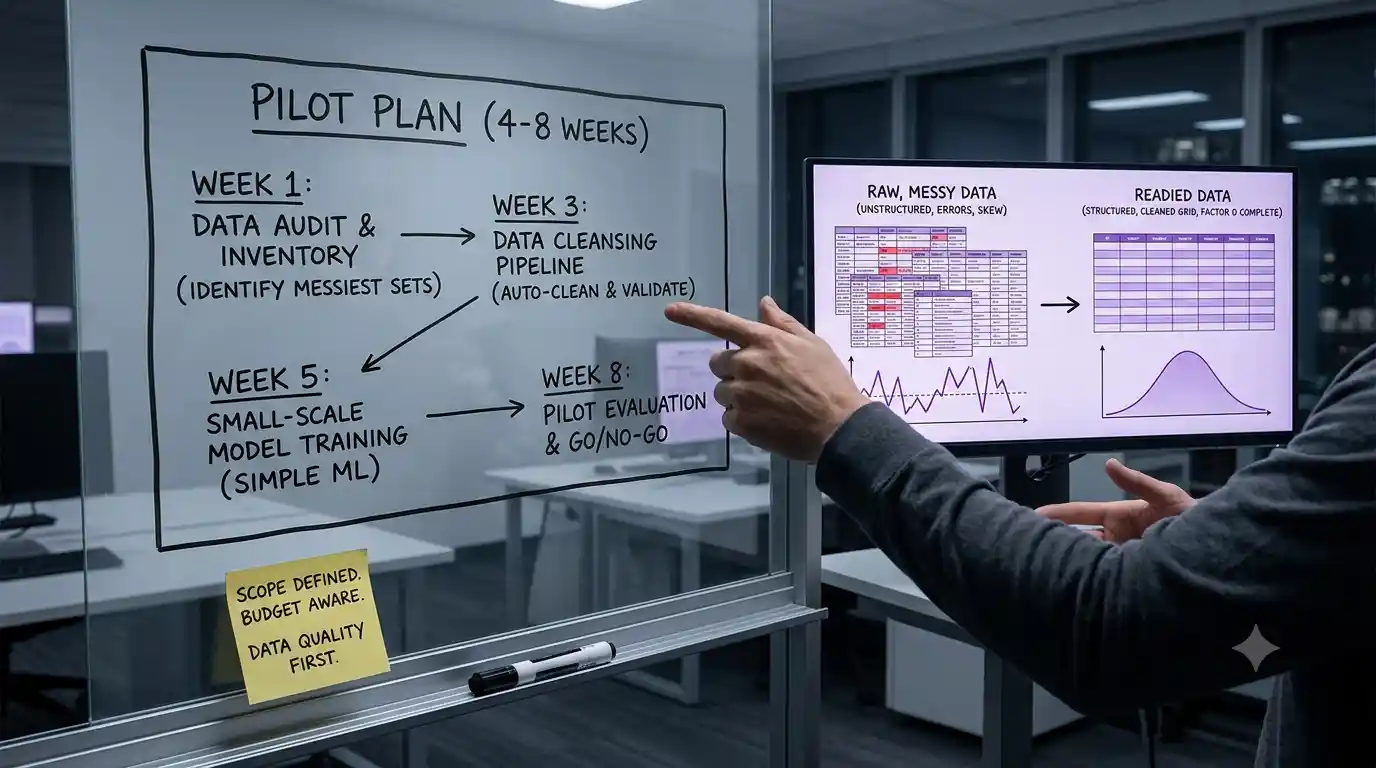
If none of the above fully closes the gap, design your first system to collect better data as a byproduct of running, not as a separate upfront project. A rules-based or simple-model version deployed today generates the labeled data your future model needs.
This staged approach also matches well with a broader proof-of-concept mindset; see our guide on how to implement AI in your business for how to sequence a pilot around limited data realistically.
The key discipline is capturing outcomes, not just inputs, from day one. If you don't log whether each decision was correct, you'll have volume without the labels that make volume useful.
Choosing the Right Approach for Your Situation
Match the strategy to your risk tolerance and timeline rather than picking the most technically impressive option. A hybrid rules-and-model approach is often the pragmatic choice for regulated or high-stakes decisions, while transfer learning suits lower-stakes classification tasks well.
Whichever approach you choose, working with a partner familiar with AI and ML app development for constrained-data situations avoids the common trap of over-engineering a solution for data volume you don't actually have.
None of these approaches require waiting a year to "collect enough data first." Every one of them lets you start now, with the data you already have, and improve from there.
FAQ
How much data do we actually need for machine learning?
It depends heavily on the task and technique, but transfer learning can produce usable results with a few hundred well-labeled examples per category. Complex tasks may need more, but very few B2B use cases genuinely require the millions of records associated with large public benchmarks.
Can we use machine learning with only a few months of historical data?
Yes, particularly if you combine that data with transfer learning or a rules-based hybrid approach. A few months of clean, consistent data is often enough for a first version, especially for a narrowly scoped use case.
Is synthetic data risky to use in a real business system?
It carries some risk if overused, since a model can learn patterns that don't reflect real-world distributions. Use synthetic data to supplement a genuine core dataset, and validate performance against real, held-out examples before deploying anything.
What's the fastest way to start if we have almost no historical data?
Start with a rules-based system that logs every decision and outcome, effectively generating your own labeled dataset as it runs. Within a few months of real usage, you'll have enough proprietary data to introduce a machine learning component.
Do public datasets actually transfer well to our specific business?
Partially. Public datasets are useful for general patterns like language structure or common image features, but rarely capture your specific business context or edge cases. Treat them as a foundation to fine-tune on top of, not a finished solution.
Should we wait until we have more data before starting?
Usually not. Waiting delays the moment you start collecting the right kind of data, which is often the actual bottleneck rather than data volume. Starting with a constrained-data approach now typically gets you to a usable system faster than waiting.
About the author
HM
Helmy Maulidina
Marketing Director
Helmy Maulidina leads marketing at Mauvelab, where she owns the organic-search strategy behind the company's B2B SaaS and custom-software content. She has spent a decade building demand for technical products, pairing hands-on SEO and content architecture with a working knowledge of how engineering teams actually ship, so that Mauvelab's writing ranks for the terms buyers search and guides them toward a strategy call.